Editorial Standards
This article is written by the Gradily team and reviewed for accuracy and helpfulness. We aim to provide honest, well-researched content to help students succeed. Our recommendations are based on independent research — we never accept paid placements.
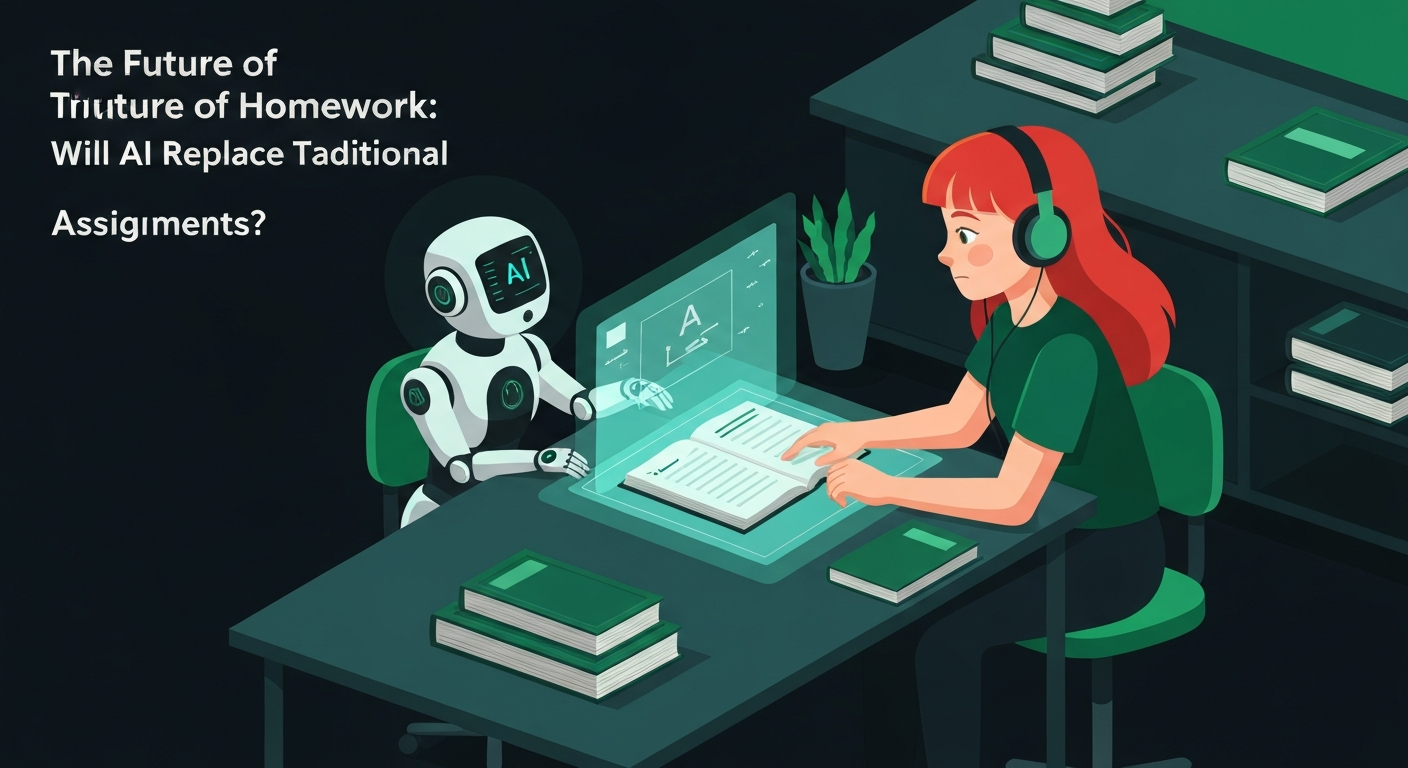
The Future of Homework: Will AI Replace Traditional Assignments?
Homework is changing fast thanks to AI. Here's what assignments might look like soon and why understanding still matters.
Table of Contents
TL;DR
- AI won't eliminate homework, but it's already changing what assignments look like
- Expect more process-based assignments, oral defenses, and AI-integrated projects
- Understanding concepts still matters — even when AI can generate answers instantly
- Students who adapt now will be better prepared for whatever comes next
Let's start with the question every student secretly wishes the answer to was "yes": Will AI make homework disappear?
Sorry, but no. Homework isn't going anywhere.
But it is changing. And honestly, some of the changes are pretty good. The days of being assigned 50 identical math problems or writing a five-paragraph essay on a topic you couldn't care less about — those might actually be numbered.
Here's what's happening and what's coming next.
Why Homework Exists (And Why AI Doesn't Make It Pointless)
Before we talk about the future, let's talk about why homework exists in the first place. It's not just busywork (although, yeah, some of it definitely is).
Homework serves a few genuine purposes:
Practice and reinforcement — You can't get good at math by watching someone else solve problems. You have to do it yourself. Same with writing, coding, science problems — skills require repetition.
Knowledge retrieval — Every time you pull information out of your brain (instead of looking it up), you strengthen that memory. This is active recall, and it's one of the most powerful study techniques that exist.
Feedback — Assignments show both you and your professor where your understanding breaks down. Without homework, the first time you'd discover a gap would be on the exam. That's way too late.
Time on task — Learning takes time. Class time alone isn't enough to master complex material. Homework extends your learning time.
AI can help with all of these things, but it can't replace the actual cognitive work that makes them effective. Getting an AI to write your essay doesn't improve your writing. Having AI solve your math problems doesn't make you better at math.
The question isn't whether homework will disappear. It's how homework will change to stay meaningful in a world where AI exists.
How Homework Is Already Changing
The Shift to Process Over Product
This is the biggest change happening right now. Instead of just grading your final essay, professors are grading your process:
- Brainstorming documents
- Outlines and drafts
- Revision history (some professors check Google Docs version history)
- Reflection memos explaining your thinking
This makes it way harder to just hand an assignment to AI, because you need to show your work at every stage. It's also arguably better pedagogy — the process of writing is where learning happens, not in the polished final draft.
More In-Class Work
Some professors have swung hard in the other direction: they're moving everything into the classroom. Timed essays, in-class problem sets, live coding exercises. If you're doing the work in front of them, they know it's yours.
This has trade-offs. In-class work adds time pressure that some students find stressful (especially students with testing anxiety). But it does solve the "did they actually do this?" question definitively.
AI-Integrated Assignments
This is the most interesting development. Instead of banning AI, some professors are saying: "Use it. But here's the catch."
Examples of AI-integrated assignments:
- "Use an AI tool to generate an essay outline, then critique and improve it"
- "Ask AI to solve this problem, then identify any errors in its solution"
- "Generate three potential thesis statements using AI, then explain which is strongest and why"
- "Use AI to research a topic, then write an original analysis that goes beyond what the AI provided"
These assignments actually teach students to think critically about AI output, which is arguably one of the most useful skills you can have right now.
Oral Components
Oral exams and presentations are making a comeback. It's hard to fake understanding when a professor is asking you follow-up questions in real time. Some schools now require "defense" conversations alongside submitted written work, similar to graduate-level thesis defenses.
What Homework Might Look Like in 5 Years
Adaptive, AI-Generated Practice
Instead of everyone getting the same 30 textbook problems, imagine AI that generates custom practice sets based on your individual weaknesses. Struggled with factoring? Here are 10 factoring problems. Already solid on that? Skip it and move to the next concept.
This already exists in some form (Gradily and similar tools offer this), but it'll likely become standard in course management systems. The homework you get will be different from the homework your classmate gets, because you have different gaps.
Competency Checkpoints Instead of Deadlines
The traditional homework model is: "Do this by Friday." The future model might be: "Demonstrate mastery of these concepts whenever you're ready."
This competency-based approach lets students move at their own pace. Some students might master Chapter 5 material in two days. Others might need two weeks. Both are fine, as long as understanding is eventually demonstrated.
AI makes this possible by providing continuous assessment and instant feedback, rather than requiring professors to manually grade everything on a fixed schedule.
Collaborative AI Projects
Future assignments might explicitly involve working with AI as a teammate:
- "Use AI to build a first draft, then substantially revise it to reflect your own analysis"
- "Create an AI-assisted research summary, then fact-check every claim and cite primary sources"
- "Develop a coding project using AI as a pair programmer, and document which parts are yours vs. AI-assisted"
This mirrors how professionals actually work with AI today. Teaching students to collaborate with AI effectively is arguably more valuable than teaching them to work without it entirely.
Portfolio-Based Assessment
Rather than individual assignments, some courses might shift to portfolio models where students collect a body of work over the semester. AI can help with individual pieces, but the portfolio as a whole needs to demonstrate growth, voice, and consistent quality — things that are hard to fake.
Why Understanding Still Matters (Even When AI Can Answer Everything)
Here's the philosophical question at the heart of all this: if AI can solve any problem and write any essay, why do students need to learn to do these things themselves?
A few reasons:
You Can't Use What You Don't Understand
AI gives you outputs. But if you don't understand the underlying concepts, you can't:
- Judge whether the AI's output is correct
- Apply concepts to new situations the AI hasn't encountered
- Build on foundational knowledge in advanced courses
- Have meaningful discussions with professors, classmates, or future colleagues
A student who "learned" organic chemistry by having AI do all their homework will absolutely crash in the next-level course. Knowledge builds on itself. There are no shortcuts through understanding.
Exams Still Exist
Until the entire educational system shifts to competency-based assessment (which will take years, probably decades), you'll still need to pass exams. And most exams don't let you use AI.
Studying effectively for exams requires having actually learned the material. AI can help you learn it faster and more efficiently, but it can't take the test for you.
Real-World Jobs Require Understanding
Your future employer doesn't just want someone who can prompt an AI. They want someone who can think critically, spot errors, make judgment calls, and bring original ideas to the table. Those abilities come from actually understanding your field, not from outsourcing your education.
It Feels Good to Actually Know Things
This might sound cheesy, but there's genuine satisfaction in understanding something deeply. The moment when a difficult concept clicks — when you go from confused to "oh, I get it" — that's one of the best feelings in education. AI can't give you that feeling. Only real learning can.
How to Approach Homework Right Now
Given all these changes, here's a practical approach to homework in the current AI era:
1. Do the thinking yourself first. Before reaching for any AI tool, spend time struggling with the material. That struggle is where learning happens.
2. Use AI to fill gaps, not do the work. When you're stuck, use tools like Gradily to understand the concept, not just get the answer. Ask for explanations, not solutions.
3. Verify AI outputs. When AI helps with research or problem-solving, always double-check the results against your textbook or course materials.
4. Show your process. Even if your professor isn't explicitly grading your process, keep notes on your thinking. This protects you and also reinforces learning.
5. Know your school's policies. College AI policies are evolving rapidly. Make sure you know what's allowed in each of your courses.
6. Prepare for the "why." If you use AI to help with an assignment, make sure you can explain everything in it. If your professor asks "why did you take this approach?" you should have a real answer.
The Bigger Picture
Homework has always evolved with technology. Calculators didn't kill math homework — they shifted it toward problem-solving and away from arithmetic. The internet didn't kill research papers — it shifted them toward source evaluation and analysis.
AI won't kill homework either. It'll shift it toward higher-order thinking: analysis, evaluation, creation, and critical reasoning. The routine, mechanical parts of assignments — the parts that felt like busywork — those will fade. What'll remain is the stuff that actually requires a human brain.
And honestly? That's a better version of homework than what most of us grew up with.
The transition will be messy. Professors are still figuring things out. Policies are inconsistent. Some assignments feel outdated while others feel unfairly restrictive. That's normal during a major technological shift.
Your job as a student isn't to figure out all of this. It's to keep learning, use AI ethically and effectively, and develop the skills that will serve you long after graduation.
The homework of the future will be different from what you're doing now. But the fundamental purpose — helping you learn and grow — isn't going anywhere.
Ready to ace your classes?
Gradily learns your writing style and completes assignments that sound like you. No credit card required.
Get Started Free